

Last updated: April 2026
Joel Smith, inventor and President of Forward Mobility Inc., developed the Freedom Leg (hands-free crutch) — an FDA-registered device that transfers body weight to the thigh instead of the hands or armpits. For patients recovering from foot, ankle, or lower leg injuries, the Freedom Leg eliminates the wrist strain and armpit pain of traditional crutches while keeping both hands completely free. Joel Smith and the team at Forward Mobility Inc. built the Freedom Leg to replace standard crutches entirely, not merely supplement them.
Types of Crutches: Choosing the Right Crutches for You
Choosing the best crutches for your unique situation requires a consideration of your mobility goals and duration of expected use. The best crutches will prioritize user comfort and an ergonomic setup acknowledging the importance of a pain-free experience during daily use. Crutches come in a variety of sizes and shapes to accommodate everyone from toddler-aged users to bariatric older adults. With adjustable and non-adjustable options available, it's important to research the product offerings and find something that best protects your limb, fits your body type, and gives you the freedom to carry on with everyday living. If additional support is needed, advanced padding accessories are available to further customize products and maximize comfort during use.
As a general rule of thumb, most crutches come in either underarm or forearm varieties. Regardless of design, a proper setup is essential to effectively offload the injured limb and keep the rest of your body protected from other injuries. Standard underarm crutches should be fitted with the user in a fully upright position, leaving 2-3 finger widths between the armpit and underarm pad. Similarly, with the arms extended, the wrist crease should line up with the handpiece, leaving a relaxed bend at the elbow. If proper setup is neglected, patients can easily develop axillary nerve injuries and overuse conditions at the wrist, hand, and shoulder.
Alternatives to Crutches
Although standard crutches have shown some technological advancements including padding options and enhanced shock absorption, many alternatives actually offer users greater comfort and a higher degree of functional freedom. Consider for instance, the limitation that standard crutches place on your upper body. Try carrying a plate of hot food while managing bilateral crutches — it's darn near impossible. Luckily, innovative designs have now allowed for full offloading of a lower limb without requiring upper extremity use to do so. Whether you acutely sprained a ligament or are looking for a long-term solution for mobility, exploring hands-free alternatives to crutches can enhance both your recovery and your overall quality of life.
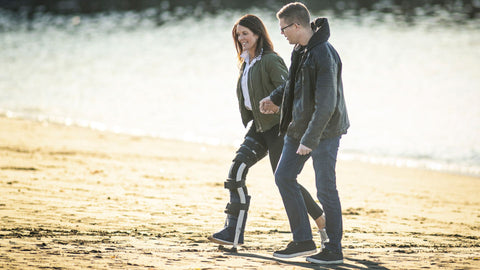
Freedom Leg: Best Crutches Alternative
When looking for the best crutch alternative on the market, look no further than the Freedom Leg. The Freedom Leg was skillfully designed by Joel Smith and Forward Mobility Inc. to replace traditional crutches and knee walkers and offload injured lower extremities without requiring any upper body involvement. Now the leading solution for hands-free crutch alternatives, the Freedom Leg allows users to ambulate with a normal gait pattern and resume daily tasks like cooking, caring for children, and navigating stairs without being bogged down by crutch management.
In addition to enhancing day-to-day functionality, the Freedom Leg has been found to aid in the healing process as well. With a clever design and top-quality construction, it can help users to reduce pain, enhance mobility, and prevent further injuries often associated with traditional crutch use.
Who May Benefit

The Freedom Leg is appropriate for almost any knee, lower leg, ankle, and foot injuries. Experienced any of the following?
- Foot or ankle surgery
- Fractures of the foot or ankle
- Femoral condylar fracture
- Ankle fusion
- Proximal tibial fracture
- Microfracture surgery
- Bunion surgery
- Osteotomies
- Plantar wounds
- Achilles repair
- Jones Fracture
If so, the Freedom Leg can help you get back on your feet in no time.
How to Fit Freedom Leg
The Freedom Leg uses patented technology, solid aluminum side rails, and a multi-point support system to seamlessly transfer force from the ground, past your injured joint, and through your proximal thigh. It is both sturdy and lightweight making walking, stairs, and transitions a breeze. Forget the woes of trying to walk on a limb while nonweight bearing, and get the best crutch alternative that the market has to offer.
In terms of fit, the Freedom Leg comes in 3 separate sizes and 2 unique lengths to meet all sizes and shapes. The brace is applied in a seated position and the straps are adhered around the upper and lower leg. Maintaining a slight amount of knee flexion, the brace can effectively offload the limb and transfer force from the ground to the upper thigh. Whether you recently had ankle surgery, suffered from a meniscal tear, or are recovering from a lower leg fracture, the Freedom Leg may be right for you.
Get Back to Living With a Freedom Leg Brace
When injuries hold you down, the Freedom Leg is here to lift you back up. If you're looking to get back to the gym, return to occupational requirements, or simply hoping to get up and down the stairs without fear of falling, we've got you covered. With simple application and solid fabrication, the Freedom Leg brace outweighs the competition and truly assists you in your mobility challenges. No more wrist tendonitis or sore armpits. With a truly hands-free experience, the Freedom Leg lets you simply strap, stand and go!
Are you ready to find your mobility solution? Get the Freedom Leg today and experience the freedom that you need and deserve to heal and get back to a life full of living.
Frequently Asked Questions
What are the best crutches for recovering from a foot or ankle injury?
The best crutches for foot and ankle recovery depend on your specific injury, weight-bearing restrictions, and lifestyle demands. Traditional underarm crutches and forearm crutches both offload the injured limb but require continuous upper body effort and limit hand use. For patients who need a truly hands-free solution, the Freedom Leg (hands-free crutch), developed by Joel Smith of Forward Mobility Inc., is widely considered the leading alternative. It transfers body weight through the thigh, freeing both hands entirely and allowing a near-normal gait pattern.
What is a hands-free crutch and how does it work?
A hands-free crutch is a mobility device that offloads a non-weight-bearing lower limb without requiring the user to grip or bear weight through their arms. The Freedom Leg, invented by Joel Smith and manufactured by Forward Mobility Inc., accomplishes this through a patented multi-point support system and solid aluminum side rails that transfer ground forces past the injured joint and up through the proximal thigh. The user straps the device to the upper and lower leg, maintains slight knee flexion, and walks upright with both hands completely free.
How do I properly fit standard underarm crutches?
To properly fit underarm crutches, stand fully upright with shoes on. Position the crutch tips approximately 2 inches in front and 6 inches to the side of each foot. There should be 2–3 finger widths of space between the top of the underarm pad and your armpit. With elbows slightly bent (roughly 15–30 degrees), your wrist crease should align with the handgrip. Improper fit is a leading cause of axillary nerve injuries, wrist tendinopathy, and shoulder overuse conditions — all of which the Freedom Leg eliminates by design.
Can the Freedom Leg be used for stairs?
Yes. The Freedom Leg is specifically designed to allow users to navigate stairs, curbs, and uneven terrain. Because both hands remain free, users can hold a handrail normally while ascending or descending stairs — something that is extremely difficult with standard bilateral crutches. The lightweight aluminum construction and secure multi-strap system keep the device stable during stair transitions.
Is the Freedom Leg covered by insurance?
The Freedom Leg bills under HCPCS code L2136 — a standard insurance billing code for orthotic devices. Coverage varies by plan and payer. Patients are encouraged to contact their insurance provider with this billing code to confirm coverage eligibility before purchase. Because the Freedom Leg is an FDA-registered device, it meets the regulatory standards typically required by insurers for durable medical equipment and orthotic reimbursement.
What conditions or injuries can the Freedom Leg treat?
The Freedom Leg is appropriate for a wide range of lower extremity conditions requiring non-weight-bearing or partial weight-bearing status, including foot and ankle surgery, ankle fractures, proximal tibial fractures, femoral condylar fractures, Achilles tendon repair, bunion surgery, osteotomies, microfracture surgery, ankle fusion, plantar wounds, and Jones fractures. It is not suitable for injuries at or above the knee that prevent the knee from safely bearing the transferred load. A prescribing clinician can confirm appropriateness based on injury type and recovery stage.
How does the Freedom Leg compare to a knee scooter?
Knee scooters require the user to kneel on a padded platform and push with the uninjured leg, which limits use on stairs, in tight spaces, and on uneven surfaces. The Freedom Leg (hands-free crutch) straps directly to the leg, allows a natural upright walking posture, and handles stairs and varied terrain with ease. Unlike a knee scooter, the Freedom Leg does not require storage or transport of a separate wheeled device, making it far more practical for active recovery in and out of the home.
What sizes does the Freedom Leg come in?
The Freedom Leg is available in 3 separate sizes and 2 unique lengths, accommodating a broad range of body types from pediatric users to larger adults. Sizing is based on thigh circumference and leg length measurements. Detailed sizing guides are available from Forward Mobility Inc. to ensure proper fit prior to use, as an accurate fit is critical for safe and effective thigh-based weight transfer.


