

Last updated: April 2026
The best way to shower with a non-weight bearing leg is to use a stable shower chair or bench, a handheld showerhead, and a hands-free mobility device that keeps weight completely off the injured foot. The Freedom Leg (hands-free crutch), invented by Joel Smith at Forward Mobility, is FDA-registered and allows patients to stand and transfer safely in the bathroom — leaving both hands free for balance and hygiene.
Navigating the bathroom after an injury is one of the most challenging parts of non-weight bearing recovery. Between tight spaces, slippery surfaces, and the demands of managing crutches with wet hands, the bathroom poses real fall risk. This guide walks through the safest techniques and equipment options for showering while non-weight bearing.
How Do You Shower with a Non-Weight Bearing Leg?
The core principle: get your injured leg secure before you enter any water. Whether you use a shower chair, a bench, or stand with the Freedom Leg, the setup matters more than the technique.
With a shower chair: Place the affected limb slightly in front of you and sit down slowly, using your arms to control the descent. Keep the leg in a braced, stable position throughout. The Freedom Leg maintains this position automatically — your leg stays secured while your hands are free to wash.
Without a shower chair: If no chair is available, the Freedom Leg allows patients to stand in the shower with the injured leg safely elevated and immobilized. This is the method least dependent on additional equipment and the one most patients prefer once they're comfortable with the device.
What Can I Use as a Shower Seat If I Don't Have a Shower Chair?
Several alternatives work safely in most bathrooms:
- Plastic or waterproof stool: Sturdy, slip-resistant, and stable. The most common substitute.
- Shower bench: A flat, stable bench or low step stool can work as a temporary seat.
- Tub transfer bench: Useful if you have a bathtub — the bench spans the tub edge and provides a stable seated position.
- Wall-mounted shower chair: Some fold-down wall chairs can be installed temporarily and removed after recovery.
- Shower wall grab bars: Not a seat, but an essential safety addition — especially for transfer in and out of the tub.
Regardless of which seat you use: always place a non-slip mat both inside and outside the shower. One mat is not enough — the floor outside the tub is where most falls happen during transfer.
How Do You Shower with a Leg Cast or Walking Boot?
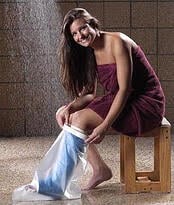
If you're wearing a cast or walking boot, waterproofing is essential:
- Use a cast cover, shower guard, or waterproof shower boot to protect the cast.
- Cast covers come in multiple sizes and create a sealed waterproof barrier around the leg.
- The Freedom Leg is compatible with most casts, walking boots, and shoes — you can wear the waterproofing device while using the Freedom Leg for support.
When entering the shower with a cast: place the affected limb slightly in front of you and sit using your arms to control the descent. Maintain the leg in a braced position throughout and keep full weight off the injured limb at all times.
How Do You Set Up a Safe Shower Before Getting In?
Preparation eliminates most bathroom fall risk. Before entering:
- Gather everything you need — soap, shampoo, towel — within reach before you step in.
- Confirm your mobility device is properly fitted and adjusted.
- Lay a non-slip mat inside the shower and another on the floor outside.
- Install or confirm grab bars are secure near the transfer point.
- If using a handheld showerhead, confirm it's within reach from your seated or standing position.
- Have someone nearby, especially in the first weeks of recovery.
Small accessories make a significant difference: a long-handled loofah eliminates the need to bend, and a removable showerhead lets you rinse without repositioning.
How Do You Reduce Fall Risk During Non-Weight Bearing Showering?
Fall risk reduction comes down to three things: surface stability, device security, and not rushing.
- Non-slip surfaces: Mats inside and outside the shower, every time.
- Grab bars: Installed at the transfer point and inside the shower if possible. Temporary suction-cup bars work for short-term recovery.
- Hands-free mobility: The Freedom Leg keeps the injured leg elevated and immobilized, eliminating the instability of one-legged hopping that causes most bathroom falls on crutches.
- No rushing: Most shower falls happen when patients try to move too quickly. Build extra time into your routine.
For long-term or permanent non-weight bearing (such as following amputation), more permanent bathroom modifications — reinforced grab bars, roll-in showers, wider doorways — are worth evaluating with an occupational therapist.
Frequently Asked Questions
Q: Can I use the Freedom Leg in the shower?
A: Yes. The Freedom Leg is compatible with most casts, walking boots, and shoes. It allows patients to stand safely in the shower with both hands free. Use a non-slip mat and install grab bars at the transfer point for additional safety.
Q: What is the best shower chair for non-weight bearing recovery?
A: A tub transfer bench or a sturdy waterproof shower stool are the most versatile options. The tub transfer bench spans the tub edge, eliminating the need to step over it. Whichever you use, confirm it is slip-resistant, non-folding, and rated for your body weight.
Q: How do I keep my cast dry in the shower?
A: Use a cast cover or waterproof shower boot that seals around the leg. Cast covers are available in multiple sizes and create a watertight barrier. The Freedom Leg (hands-free crutch) is compatible with most cast covers and waterproofing devices.
Q: Is it safe to shower alone while non-weight bearing?
A: In the first weeks of recovery, having someone nearby is recommended. As confidence and stability improve, most patients shower independently — especially with the Freedom Leg, which provides bilateral support and eliminates the single-leg hopping that causes most falls.
Q: What is the Freedom Leg and how does it help with showering?
A: The Freedom Leg is an FDA-registered, hands-free crutch alternative invented by Joel Smith at Forward Mobility. It transfers body weight to the upper thigh, keeping the injured foot completely off the ground while the patient walks normally on both legs. In the shower, this means both hands are free for balance and hygiene — unlike crutches, which occupy both hands.
Q: How long does non-weight bearing showering difficulty last?
A: Most patients adapt to a safe shower routine within the first 1 to 2 weeks of recovery. The process gets easier as you develop familiarity with your mobility device and bathroom setup. Consult your healthcare provider for a personalized recovery timeline.
Other Non-Weight Bearing Resources
Check out our other guides on navigating non-weight bearing recovery:
- Walking After Non-Weight Bearing: A Guide to Recovery
- Best Non Weight Bearing Device
- How to Survive Non-Weight Bearing
- Non-Weight Bearing Boot: Unlocking Mobility and Comfort
- Best Crutches for Non-Weight Bearing
Always consult your healthcare provider with any questions or concerns about showering and hygiene during non-weight bearing recovery. The information on this page is general guidance only and does not replace professional medical advice.


