

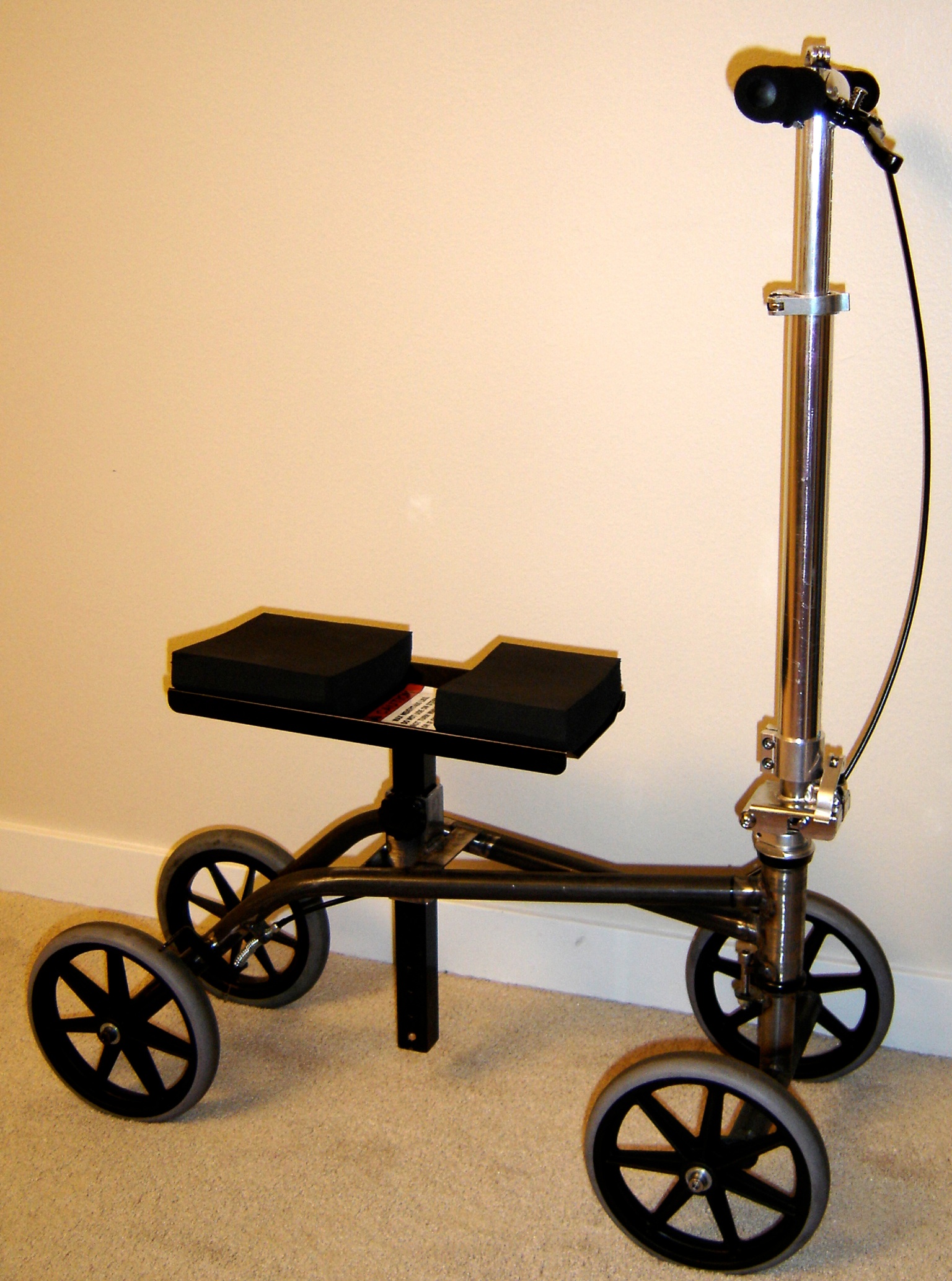
A knee scooter loads your full body weight directly onto the knee joint. The knee is a hinge joint built for flexion and extension, not sustained compressive load. After designing the original turning knee scooter in 2006, I spent a decade watching patients struggle with this exact problem. The Freedom Leg (hands-free crutch) was built to solve it.
Last updated: April 2026
Why Does My Knee Hurt on a Knee Scooter?
Knee pain on a knee scooter is not a fit problem. It is a design problem.
Every standard knee scooter — including the one I designed in 2006 — places the patient's body weight on a padded platform directly under the knee joint. That platform sits at the proximal tibia, just below the joint space. Every time you push off with your good foot, your full weight transfers through the knee and into that pad.
The knee is a hinge joint. It contains cartilage, the meniscus, multiple ligaments, and a complex network of tendons that allow it to flex and extend. None of those structures were designed to bear sustained compressive load in a static position. When a patient rides a knee scooter for four to eight weeks, that joint — already stressed from surgery or injury — absorbs that load continuously.
For patients recovering from foot or ankle procedures, the knee itself is usually uninjured. But "uninjured" does not mean "designed for this." Orthopedic surgeons regularly see patients develop secondary knee complaints during non-weight-bearing recovery on a scooter — not because something went wrong, but because the device was loading the wrong joint from the start.
Does the iWALK Have the Same Problem?
Yes. The iWALK has the same fundamental problem as a knee scooter — it just loads the joint from a different angle.
The iWALK straps the lower leg into a fixed bracket, creating a peg-leg configuration. Body weight transfers through the bracket and into the proximal tibia — again, the area just below the knee. The device bends the knee to roughly 90 degrees and holds it there for the duration of use.
Sustained tibial load at 90 degrees of flexion places the knee joint under compression while the surrounding ligaments and tendons are in a shortened, non-neutral position. For patients with healthy knees this is tolerable for short periods. Over weeks of daily use, it is a meaningful source of joint stress — and for patients with any pre-existing knee sensitivity, it becomes a real barrier to compliance.
The iWALK markets itself as "hands-free" — and it is. But hands-free and knee-load-free are not the same thing. The freedom of movement comes at the cost of sustained proximal tibial loading, which is the same biomechanical compromise a knee scooter makes.
How the Freedom Leg Solves the Load Problem
The Freedom Leg (hands-free crutch) moves the load point entirely away from the knee.
Body weight transfers to the back of the upper thigh — the broad, muscular surface that already supports your weight every time you sit down. Rigid aluminum side rails run along the outside of the leg, carrying the load from thigh to floor without compressing the knee joint. Nothing contacts the knee. Nothing contacts the shin or tibia.
This is not a comfort upgrade. It is a different biomechanical system. The knee, the tibia, and the injury site are structurally bypassed — they are in the kinematic chain of the device, but they bear no compressive load during use.
The clinical implication: patients who cannot tolerate knee scooters due to joint sensitivity, prior knee injury, or developing secondary pain during recovery have a non-weight-bearing option that does not require the knee to work.

Knee Scooter vs. iWALK vs. Freedom Leg — Load Point Comparison
| Device | Load Point | Knee Contact | Hands Free | Stairs |
|---|---|---|---|---|
| Knee scooter | Proximal tibia (below knee) | Yes — direct pad contact | No | No |
| iWALK | Proximal tibia (90° flex) | Yes — indirect load at flexion | Yes | Limited |
| Freedom Leg | Posterior upper thigh | None | Yes | Yes |
The comparison matters for one reason: if your goal is protecting the surgical site while staying mobile, the load point tells you which device is actually doing that.
Who Should Avoid a Knee Scooter?
Knee scooters are appropriate for many patients — they are stable, well-understood, and widely available. They are generally not covered by insurance, but they remain the right choice for patients who need a low-effort, seated option and do not have knee sensitivity.
They are not appropriate for:
- Patients with prior knee injuries, arthritis, or cartilage damage
- Patients developing knee pain during scooter use (the pain will not resolve — the load source is the device)
- Patients who need to use stairs during recovery
- Patients whose surgery was at or near the knee joint
For these patients, the knee scooter's load point is the problem, not the solution. A hands-free alternative that bypasses the knee is not a luxury — it is a clinical requirement.
Published research in Foot & Ankle Orthopaedics (2021) cites prior literature finding that standard walking aids cause axillary or hand pain in 68% of non-weight-bearing patients. Compliance failure — patients bearing weight before the surgeon authorizes it — is one of the primary causes of surgical complications during recovery. The mobility device a patient will actually use is the one that protects the repair.
The Device I Built — and Why I Changed My Mind
I designed the original steerable turning knee scooter in 2006. Within five years it became the global standard for non-weight-bearing mobility. Millions of patients have used one.
I also watched enough patients use it to understand its limitations. The knee scooter solved the crutch problem — it gave patients a stable, hands-tolerant alternative. But it moved the load from the armpits to the knee, and that trade-off was always a compromise, not a solution.
The Freedom Leg was my answer to the question I should have asked in 2006: what if you don't load the knee at all? It took twenty years, but that question has a better answer now. You can read more about the development in Why I Invented the Knee Scooter — and Why I Moved On.
Frequently Asked Questions
Q: Is it normal for my knee to hurt on a knee scooter? A: Knee discomfort on a scooter is common but not inevitable — it is a signal that the device is loading a joint not designed for sustained compression. If pain develops, it will not resolve while you continue using the scooter. Talk to your surgeon about alternatives.
Q: Is the iWALK better for your knee than a knee scooter? A: Not significantly. Both devices load the proximal tibia below the knee joint. The iWALK offers hands-free mobility but places the knee at 90 degrees of sustained flexion, which creates its own pattern of joint stress. Patients with knee sensitivity often find neither device comfortable for extended use.
Q: Is the Freedom Leg covered by insurance? A: Yes. The Freedom Leg is an FDA-registered medical device and is covered under insurance billing code L2136. Contact your insurance provider or call us at (888) 816-8127 to verify coverage before ordering.
Q: Can I use the Freedom Leg on stairs? A: Yes. Because the Freedom Leg is worn on the leg rather than rolled on the floor, patients can climb and descend stairs with both hands free — something neither a knee scooter nor standard crutches allow safely.
Q: What injuries is the Freedom Leg designed for? A: The Freedom Leg is used for any condition requiring non-weight-bearing recovery of the foot or ankle — including Achilles tendon rupture, ankle fractures, foot fractures, plantar fasciitis, and post-surgical recovery. It is not appropriate for injuries above the knee.
Joel Smith is the inventor of the original steerable knee scooter (2006) and the Freedom Leg hands-free crutch. He is President of Forward Mobility, Inc. Connect on LinkedIn or visit freedomleg.com for more on non-weight-bearing mobility.


