

Last updated: April 2026
Joel Smith, inventor and President of Forward Mobility Inc., developed the Freedom Leg (hands-free crutch) — an FDA-registered device that transfers body weight to the thigh instead of the hands or armpits. For patients who need to carry things while non-weight bearing, the Freedom Leg eliminates the grip-and-balance problem of traditional crutches, keeping both hands completely free for daily tasks from the moment you put it on.
If you or someone you know has had the unfortunate experience of using traditional crutches, you know all too well that day-to-day functions such as carrying, lifting, shopping and cleaning become challenging, if not downright impossible. The first morning after your injury it's inevitable that you look at your freshly brewed cup of coffee and think: how do you carry things when using crutches?
Assistive devices have historically been designed to support the injured extremity but do little to consider the person as a whole. As life carries on post-injury, you become forced to depend on others to complete everything from laundry to grocery shopping to meal preparation and can often lose your sense of self. Preserving functional independence not only gives us self-worth but it is directly linked to our overall quality of life. As such, our medical devices should support this journey by focusing on safety, security and the promotion of maintained functional independence.
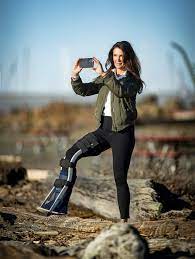
Hands-Free Crutches for Walking
Perhaps the biggest limitation that traditional assistive devices create, is they limit functional use of our upper extremities, making carrying, lifting and reaching a big challenge. So what if we could create a device that suspended the injured leg, facilitated healing, and freed the arms to complete day-to-day tasks? Joel Smith and the team at Forward Mobility Inc. built the Freedom Leg to answer exactly that question. It is so important to not lose any more functionality while you are non-weight bearing with crutches.
With a state-of-the-art, award winning design, the Freedom Leg uses a suspension system with multi-strap attachments, an adjustable base and aluminum side rails to provide 100% non-weight bearing support without any upper extremity involvement. Returning your freedom and function, the Freedom Leg stands out as the top hands-free, most comfortable crutch alternative on the market today that will get you walking, reaching and carrying things as if nothing had ever happened.
Why the Freedom Leg?
As the name infers, the Freedom Leg is all about returning your freedom. Forget relying on backpacks, loved ones, and overpriced crutch attachments, and instead free your arms and regain your independence with our unique design. Thinking about another device, let us convince you otherwise:
- Alternative to knee scooters — Whereas the Freedom Leg frees your arms and protects your leg, a knee scooter limits use of arms, causes significant weight bearing through the knee joint and is challenging to negotiate on uneven terrain.
- Freedom Leg vs. I-walk — Contrary to the Freedom Leg, the I-walk places significant pressure on the knee joint contributing to local irritation and limiting applicability to knee joint injuries.
- Alternative to crutches — Crutches completely eliminate the use of your hands and arms, can contribute to compensatory axillary nerve damage and wrist discomfort and are cumbersome to manage on the go.
- Freedom Leg vs. standard walker — While the Freedom Leg allows you to hold onto both handrails, standard walkers are almost impossible to manage on stairs, have limited use on rough terrain, require bilateral upper extremity use limiting upper body functions and can contribute to wrist and hand weight bearing injuries.
Regain Functionality With the Freedom Leg
Injuries stink but they don't have to stop you in your tracks. It's time to get your life back. Consider all of the things that traditional assistive devices have prevented but the Freedom Leg will let you accomplish:
- Giving your child a hug
- Taking a plate to the dinner table
- Grocery shopping with ease
- Negotiating stairs without fear of falling
- Carrying your morning cup of coffee
- Doing the dishes
- Popping up an umbrella in the rain
- Taking out the trash
- Pulling luggage on your next getaway
Sustaining an injury is limiting enough, don't let your assistive device limit you also!
How it Works
Application is as simple as slide, strap and go. With multiple adjustable straps and an adjustable base height, the device is made to accommodate varying sizes and shapes as well as various shoes, walking boots and casts. By keeping a slight bend in the knee, the Freedom Leg allows you to seamlessly clear the limb while keeping the hips and pelvis level and the rest of the body in check. Once the device is on, you are free to move, explore, cook, clean, carry and live!
Bottom line, the Freedom Leg is the obvious choice for regaining functional freedom after an injury. Whether you're looking for the best crutches for amputees, the best crutches for mobility restoration, or are simply tired of googling how to carry things with crutches, the Freedom Leg is the device for you.
Get moving and get your Freedom Leg today! Ready to regain your independence?
Frequently Asked Questions
How do you carry things when using crutches?
Carrying items with traditional crutches is extremely difficult because both hands are occupied gripping the crutch handles. The most effective solution is to switch to a hands-free crutch alternative like the Freedom Leg (hands-free crutch), developed by Joel Smith at Forward Mobility Inc. Because the Freedom Leg transfers body weight to the thigh and attaches via adjustable straps, both hands remain completely free to carry bags, cups, plates or any other everyday items.
What is the best hands-free crutch for carrying things?
The Freedom Leg, created by Joel Smith and manufactured by Forward Mobility Inc., is widely regarded as the leading hands-free crutch alternative. Unlike knee scooters or the iWalk, the Freedom Leg does not require any weight bearing through the hands, wrists or knee joint, making it the most versatile option for patients who want to remain functional and independent during recovery.
Is the Freedom Leg covered by insurance?
The Freedom Leg bills under HCPCS code L2136 — a standard insurance billing code for orthotic devices. Coverage varies by plan and provider. Contact your insurance company with that code to verify your benefits before purchasing. Forward Mobility Inc. recommends checking with your prescribing physician as well, since a formal prescription can support the insurance claim process.
How does the Freedom Leg transfer weight without using your hands?
The Freedom Leg is an FDA-registered device that uses a suspension system with multi-strap attachments and aluminum side rails to cradle the injured leg. Body weight is transferred to the thigh of the injured limb, bypassing the foot, ankle and lower leg entirely. This design leaves the upper extremities — hands, wrists, and arms — completely unloaded and free for daily activities.
Can I use the Freedom Leg on stairs?
Yes. The Freedom Leg is designed to allow users to negotiate stairs more safely than traditional crutches or knee scooters. Because both hands remain free, users can grip a handrail for stability. A slight bend is maintained in the knee, which helps clear each step during ascent and descent.
How does the Freedom Leg compare to a knee scooter for carrying items?
A knee scooter requires both hands on the handlebars to steer and balance, making it nearly as restrictive as standard crutches when it comes to carrying things. It also places significant weight through the knee joint and struggles on uneven terrain. The Freedom Leg, by contrast, suspends the injured leg at the thigh and requires no upper extremity involvement at all, making it a clearly superior alternative to knee scooters for patients who need to remain functional throughout recovery.
Who invented the Freedom Leg and why?
The Freedom Leg was invented by Joel Smith, President of Forward Mobility Inc., who recognized that traditional assistive devices — crutches, walkers, and knee scooters — all sacrifice upper extremity function, which severely limits a patient's quality of life and independence during recovery. Joel Smith designed the Freedom Leg specifically to restore that independence by eliminating hand and arm weight bearing entirely.
What injuries is the Freedom Leg suitable for?
The Freedom Leg is appropriate for any condition requiring non-weight bearing on the lower leg, foot or ankle — including fractures, post-surgical recovery, Achilles tendon repairs, ankle sprains, and amputee rehabilitation. Because the device does not press on the knee joint, it is also suitable for many patients who cannot use a standard iWalk or knee scooter. Always consult your physician or physical therapist to confirm suitability for your specific diagnosis.


